
This was my daddy's favorite hymn. It may not be the best version, ever, but I just wanted to do it in Daddy's memory.
x
Tuesday, February 8, 2011

Sunday, February 6, 2011
The Blues Are Calling

Luckily, it's not blocked for the blues, however...
I bought this phone at the thrift store, a couple of days ago, for the $6.99 marked price. Why, you might ask, would I want an old rotary phone? Well, I really didn't.
But, I did want the handset. The speaker in the earpiece of the phone produces sound by converting electrical impulses into vibration, which produces the sound you hear on the phone. It will also work in the opposite manner: It will convert vibration into electrical impulses.


The output jack, located on the lower left corner of the body, is relatively subtle. I don't think it detracts from the looks of the guitar, too much.
And, it sounds pretty good through the Pignose amp, in my opinion.
x
Saturday, February 5, 2011
Cigar Box Guitar
A few weeks ago, I decided that I'd try my hand at building a cigar box guitar. Having listened to a lot of Seasick Steve, lately, I figured I'd go with three strings. I have the St. George set up as a 3-string, and I'm having a good time playing slide on it. But, I think that the cbg works even better with 3 strings.
I went to the Rockler Woodworking store, over on Colorado Blvd, and picked up a 1x2x48 stick of Jatoba wood (Brazilian Cherry). Jatoba is hard and dense, so I hoped that it would hold up well to string tension, since I wasn't planning on using any metal reinforcing.
I wanted to build the guitar in a fairly traditional manner, using no power tools other than a circular saw and a drill. Eventually I deviated from the traditional tools by using a Dremel and SuperGlue, in the interest of saving time.
 I started off by roughing the shape of the neck in with a knife.
 Then, I went to the wood rasp to refine it a bit.
Eventually, I used sandpaper backed with duct tape to do the final shaping. I used the circular saw to remove the wood where the neck runs under the body, and where the tuners go. It was tedious, and nerve-wracking to make repeated cuts, side by side, removing a saw-blade's width of material with each pass, to remove the wood.
 I glued on a 1/4"x2" maple fingerboard (left over from another project, also bought at Rockler) and marked the fret positions. I then used my miter box and saw to slot the fingerboard. A little round-file work made room for the frets to be set down into the wood. The frets are cut-off sections of 14 gauge stainless steel bicycle spokes, and they are held in place with SuperGlue.
 Once the frets were set, I started work on a bridge.
 The bridge is made from a bone nut glued onto a short section of the same maple which makes up the fingerboard. I "ebonized" the maple with a Sharpie.
The tailpiece is a belt buckle which I found at the thrift store, with three holes drilled in it for the strings to pass through.
 Sound holes in the side allow for more air movement which, in turn, allows the top to vibrate more freely.
 So, there it is. Later, I plan on installing a piezo pickup, so that I can plug it in. Until then, it is acoustic. To hear it, check out the video.
x
I went to the Rockler Woodworking store, over on Colorado Blvd, and picked up a 1x2x48 stick of Jatoba wood (Brazilian Cherry). Jatoba is hard and dense, so I hoped that it would hold up well to string tension, since I wasn't planning on using any metal reinforcing.
I wanted to build the guitar in a fairly traditional manner, using no power tools other than a circular saw and a drill. Eventually I deviated from the traditional tools by using a Dremel and SuperGlue, in the interest of saving time.


Eventually, I used sandpaper backed with duct tape to do the final shaping. I used the circular saw to remove the wood where the neck runs under the body, and where the tuners go. It was tedious, and nerve-wracking to make repeated cuts, side by side, removing a saw-blade's width of material with each pass, to remove the wood.


The tailpiece is a belt buckle which I found at the thrift store, with three holes drilled in it for the strings to pass through.


x
Saturday, December 18, 2010
Further Proof That I Am Not What You Would Call a "Collector"
I tend to end up with more than one example of things, such as bikes and motorbikes, guitars and amps, records, books, and comics...but I don't consider myself a collector, necessarily. I'm just a guy with 15 different pocket knives, all of which have been carried and sharpened so they are usable.
Collectors own things simply to own them. To a collector, a sharpened knife is ruined, and any modification of whatever it is that they collect makes that example inferior to one in a completely stock state.
But, this isn't a post about collectors. This is a post about a guitar I just bought; a 1969 Harmony H-82G Rebel, just like the one I owned 30 years ago, when I was in college.

I have a soft spot for the thinline-style Harmony hollow bodied electric guitars. One of my all-time favorite guitars I have ever owned is a 1966 Harmony H-72, which is a slightly more upscale model than the Rebel. I bought my H-72 in unused condition back in 1997, and had it sitting in my coffee shop. Lots of people played that guitar there, and many wanted to buy it. Luckily, I never made a deal on it.
I've missed my Rebel, ever since the ex-wife talked me into selling it, along with about 10 other guitars, shortly after we bought our first house. She was of the opinion that all of those guitars were wasting space.
Anyway, I decided, a couple of years back, that I would like to get another Rebel, preferably the rarer Avocado Green model like I had in the old days. So, I started watching eBay, and bidding on them. I always seemed to get outbid by $5.00, because I have a maximum amount that I am willing to pay for one of these. Finally, last week, I ended up winning one.
I was ecstatic that I had finally scored one of these guitars.
 It was a little rough around the edges, but it is over 30 years old. They can't all be as clean as my H-72. So, I was fine with it, cosmetically.
 What I wasn't too happy with, though, was the tuners. While they appeared to be stock, they were actually a collection of parts from three different sets of tuners. Click the picture to make it big, and check out the screws and cogs on each tuner. The top tuner has a replacement cog (and post, which you can't see from here), but it at least works. The third tuner down has a replacement cog, which is the wrong size, and is almost impossible to turn. This rendered the G string virtually non-tunable.
I tuned the rest of the strings to the G, and plugged the guitar into my amp, and tested it out. The neck is great, the sound is fine, and playing it was like stepping back in time. It was everything I wanted...except tunable.
That was last Monday. I spent this week thinking about what I wanted to do. Should I find a set of six-on-a-plate original-style tuners and keep the guitar "stock", or should I just use the extra set of Telecaster-style tuners I picked up in Waynesboro, Tennessee, last summer?
Here's what I decided on:


I re-drilled the headstock for the nicer tuners and bolted them down, this afternoon. I'm not worried about resale value: I don't plan on reselling this guitar on the collector's market. It has found it's final home, more than likely. So, rather than replace the non-usable stock tuners with a newer version of what are, after all, sub-par units, I decided to make the guitar easier to deal with when I am playing it.
 Here, for comparison's sake, are the Rebel and the slightly more upscale H-72. Some of the upgrades on the H-72, compared with the H-82 include the block inlays on the fingerboard, as opposed to the dots on the Rebel...
 and a bound headstock, where the Rebel's headstock is unbound, along with nicer tuners (though they are still six-on-a-plate). The tuners on my H-72 are stock, but they still work well and I see no need to replace them until they become problematic. At that point, I will go with the same style tuners I installed on the Rebel.
 I need to find some knobs for the sliding potentiometers. That's another place where I will end up with not-as-original parts, mainly because I can't find a source for the originals. It's unusual to see one of these with all of the knobs there, so it seems like some vintage guitar parts vendor would stock replacements, but none do. I suppose it's a pretty small market, even if 90% of the owners of these guitars are in need.
 I love the green color, and the back of this guitar is in pretty decent shape. It's not unusual to see a lot of belt-buckle rash on these, as the paint is not particularly durable.
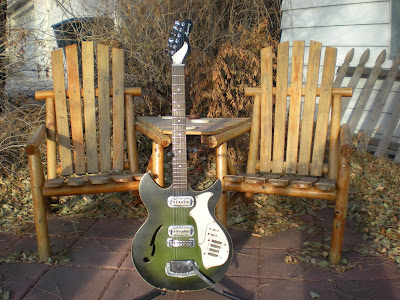 So, here's the full Monty, with the new tuners. I think we are going to make some interesting, if not beautiful, music, together...
x
Collectors own things simply to own them. To a collector, a sharpened knife is ruined, and any modification of whatever it is that they collect makes that example inferior to one in a completely stock state.
But, this isn't a post about collectors. This is a post about a guitar I just bought; a 1969 Harmony H-82G Rebel, just like the one I owned 30 years ago, when I was in college.

Here I am, playing that guitar circa 1980.
I have a soft spot for the thinline-style Harmony hollow bodied electric guitars. One of my all-time favorite guitars I have ever owned is a 1966 Harmony H-72, which is a slightly more upscale model than the Rebel. I bought my H-72 in unused condition back in 1997, and had it sitting in my coffee shop. Lots of people played that guitar there, and many wanted to buy it. Luckily, I never made a deal on it.
I've missed my Rebel, ever since the ex-wife talked me into selling it, along with about 10 other guitars, shortly after we bought our first house. She was of the opinion that all of those guitars were wasting space.
Anyway, I decided, a couple of years back, that I would like to get another Rebel, preferably the rarer Avocado Green model like I had in the old days. So, I started watching eBay, and bidding on them. I always seemed to get outbid by $5.00, because I have a maximum amount that I am willing to pay for one of these. Finally, last week, I ended up winning one.
I was ecstatic that I had finally scored one of these guitars.


I tuned the rest of the strings to the G, and plugged the guitar into my amp, and tested it out. The neck is great, the sound is fine, and playing it was like stepping back in time. It was everything I wanted...except tunable.
That was last Monday. I spent this week thinking about what I wanted to do. Should I find a set of six-on-a-plate original-style tuners and keep the guitar "stock", or should I just use the extra set of Telecaster-style tuners I picked up in Waynesboro, Tennessee, last summer?
Here's what I decided on:


I re-drilled the headstock for the nicer tuners and bolted them down, this afternoon. I'm not worried about resale value: I don't plan on reselling this guitar on the collector's market. It has found it's final home, more than likely. So, rather than replace the non-usable stock tuners with a newer version of what are, after all, sub-par units, I decided to make the guitar easier to deal with when I am playing it.


x
Saturday, October 16, 2010
Progress on the Tele


For now, though, I am just going to leave it. It works, and the imperfection of the pickup mount is of small concern. I am more interested in how it plays and how it sounds than I am with how the tiny details look.
And, it plays and sounds the way I've always wanted a Telecaster to be. This is the first one I've had on which I like the sounds of both pickups, and I love the feel and playability of it. It's definitely a keeper.

Now, I just need to make some music with it...
x
Sunday, August 29, 2010
Telecaster Project
I was down at Guitar Center, the other day, to get some nylon strings for a Kay classical I repaired, and I stopped by the used guitar rack to check out what was there. I was surprised to see a guitar I thought had been sold, back on the rack and significantly marked down.
 It is a Raines Thinline Telecaster copy. I had looked at this guitar, when it was priced at $225.00 higher, and just couldn't bring myself to pull the trigger on buying it. But, I wanted it prettry badly. I have been looking for a Thinline, for a while, but the new versions at the store, whether the $300 Squire-by-Fender models, or the $800 Fenders with the humbucking pickups just don't sound as good as I remember the vintage ones sounding.
So, I pulled the Raines down and plugged it in. Man, did it sound good! The neck felt a bit weird, but the pickups were awesome, and the chambered body added some meat to the sound, unlike the actual Fenders I plugged in as comparison. This guitar sounded like I expected a Thinline Tele to sound!
However, as one of the employees pointed out, there was reason the guitar had been marked down:
 No wonder the neck felt a little weird! It was as twisted as David Lynch's imagination.
Still, the sound was awesome, and I have a Squire Tele I bought a while back, with a bad switch and a horrible bridge pickup that I was planning on modifying. I thought about it for about 20 minutes, as I bought my strings and took them out to the car. Eventually, I went back in the store and bought the guitar (for less than the cost of the bare Thinline-style body from a guitar parts supplier), and started planning on the modifications I was going to make.
 The first thing I did was pull the neck off of the Squire, and swap it onto the Raines (I have an e-mail request in to Matt Raines to see if he will sell me a replacement neck at a reasonable cost, so I can put the Squire back together).
 One of the plans I had for the Squire was to remove the stock bridge/tailpiece combination and replace it with a trapeze-style tailpiece and a standard bridge. So, I did that with the Raines. I didn't bother making a plate to cover the pickup cavity, and hold the pickup in place, because I wanted to see if I liked the feel of this combination on the Tele as much as I do on the Harmony, the Gibson ES-125, etc.
It turns out that I do, so I will be working on a cover plate (and a higher-quality, adjustable, bridge) and I'll make it a permanent change.
 So, here it is in its new form. We'll see if Matt Raines comes through with a neck. If not, I will probably leave this one on here (it's really a nice-feeling neck), and I'll find something else to put on the Squire.
An interesting problem has made itself apparent to me, lately. For some reason, all of my guitars with single-coil pickups hum like mad, in my house, when plugged into my amp. Now, I know that humbucking pickups were developed just for curing this problem, but the hum I get in my house is much more noticeable than what I get with the same guitars and amps, elsewhere.
I don't know if the wiring in my house is contributing to it, or if there is a microwave tower close by, irradiating the heck out of me, or what. I've tried different outlets in the house, to see if it's a bad ground, but I get no difference from outlet to outlet. Oddly, the Telecasters are the worst offenders, but the Harmony and the Gibson exhibit the same problem, just not quite as pronounced.
I have a humbucking Telecaster bridge pickup I may put in the Raines (I wouldn't change the neck pickup, since it sounds so good). But, I'd rather find the underlying cause and fix it, so that I can play all of my guitars without all the noise, which is a real problem when I try to record something. I find myself using the black Tele Custom with the two humbuckers to record, regardless of which guitar I think sounds best for a particular song, simply to get a clean track recorded.
x

So, I pulled the Raines down and plugged it in. Man, did it sound good! The neck felt a bit weird, but the pickups were awesome, and the chambered body added some meat to the sound, unlike the actual Fenders I plugged in as comparison. This guitar sounded like I expected a Thinline Tele to sound!
However, as one of the employees pointed out, there was reason the guitar had been marked down:

Still, the sound was awesome, and I have a Squire Tele I bought a while back, with a bad switch and a horrible bridge pickup that I was planning on modifying. I thought about it for about 20 minutes, as I bought my strings and took them out to the car. Eventually, I went back in the store and bought the guitar (for less than the cost of the bare Thinline-style body from a guitar parts supplier), and started planning on the modifications I was going to make.


It turns out that I do, so I will be working on a cover plate (and a higher-quality, adjustable, bridge) and I'll make it a permanent change.

An interesting problem has made itself apparent to me, lately. For some reason, all of my guitars with single-coil pickups hum like mad, in my house, when plugged into my amp. Now, I know that humbucking pickups were developed just for curing this problem, but the hum I get in my house is much more noticeable than what I get with the same guitars and amps, elsewhere.
I don't know if the wiring in my house is contributing to it, or if there is a microwave tower close by, irradiating the heck out of me, or what. I've tried different outlets in the house, to see if it's a bad ground, but I get no difference from outlet to outlet. Oddly, the Telecasters are the worst offenders, but the Harmony and the Gibson exhibit the same problem, just not quite as pronounced.
I have a humbucking Telecaster bridge pickup I may put in the Raines (I wouldn't change the neck pickup, since it sounds so good). But, I'd rather find the underlying cause and fix it, so that I can play all of my guitars without all the noise, which is a real problem when I try to record something. I find myself using the black Tele Custom with the two humbuckers to record, regardless of which guitar I think sounds best for a particular song, simply to get a clean track recorded.
x
Subscribe to:
Posts (Atom)